
Colored renditions of public images featured on this page © 2025 Amanda Peck. All rights reserved.
➡️ Return to Main Art Page
Colored by Amanda
Engraving by Nicholas Camille Flammarion
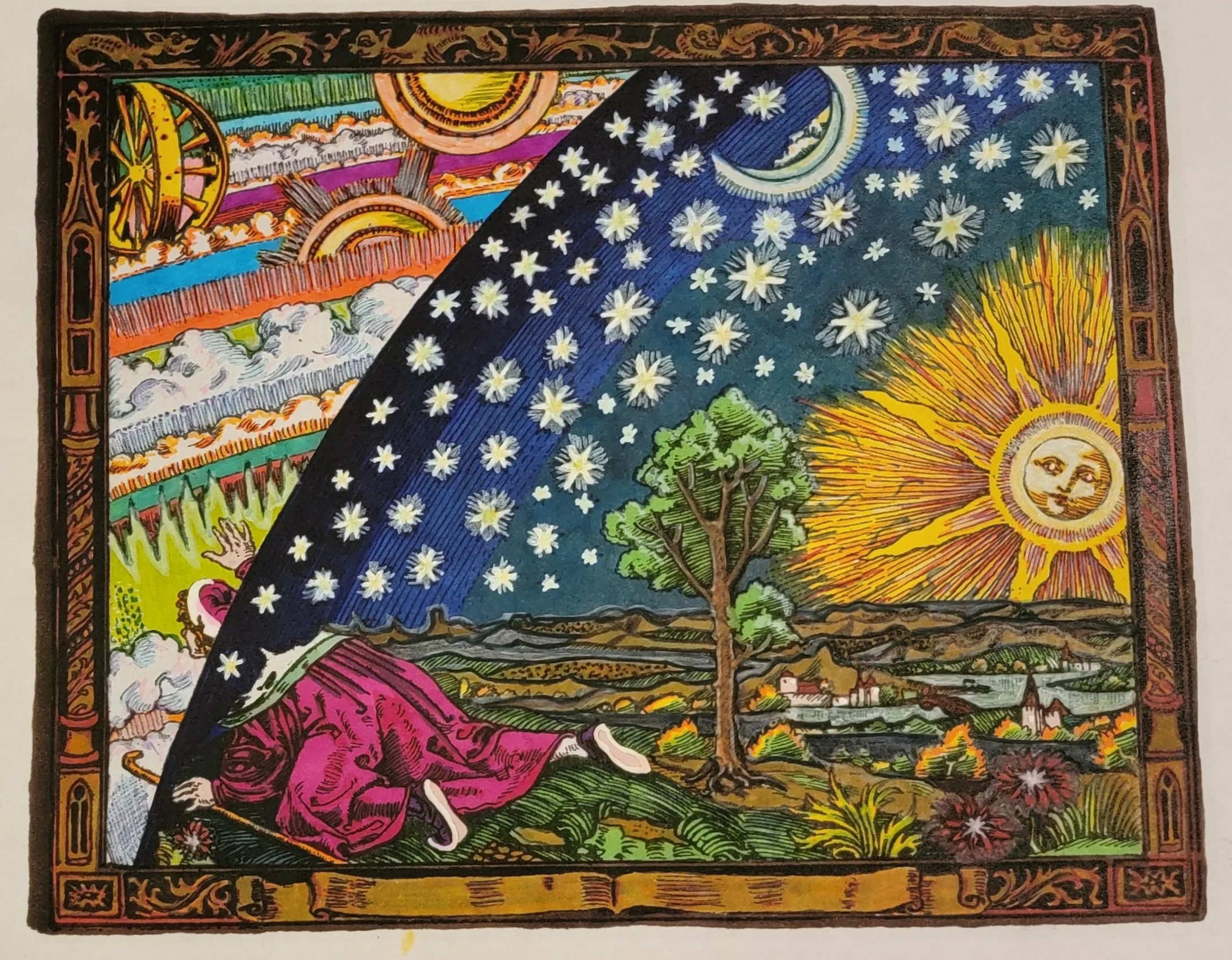
The illustration depicts a pilgrim who peeks across the firmament, the barrier between the heavens and Earth. This engraving appeared in Flammarion’s L'atmosphère : météorologie populaire (1888). Amanda hopes the difference between Earth (depicted as one expects, with traditional earthen hues) and the heavens (wild, hallucinatory, uncanny) is palpable. She imagined that the pilgrim was a holy man rather than a random pilgrim, and that the sun is made of the same substance as the ophanim in the heavens, powerful angels portrayed as the wheels of God’s heavenly chariot. In this way, the mysteries of physics and metaphysics a revealed to be the same.
Illustrated by Elenore Abbott
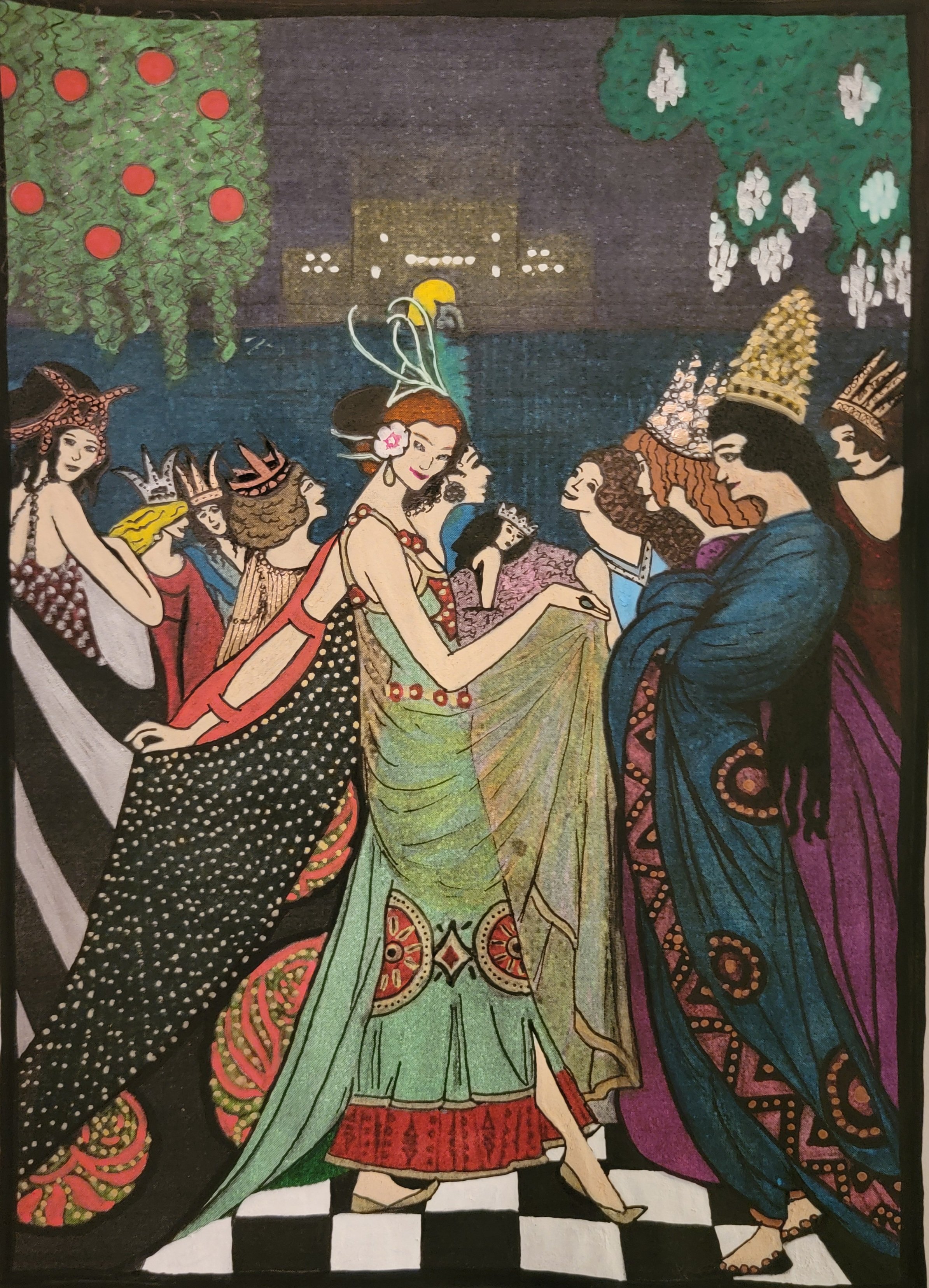
“The Twelve Dancing Princesses” (“Die zertanzten Schuhe”) is a fairy tale originally collected by The Brothers Grimm. While discussing favorite fairy tales, Amanda and Pax50 conspired to create a matching set — a coloring page and a retold story — celebrating the theme of agency. Depicted at the center of the illustration (per Amanda’s rendering) is the eldest sister of Pax50’s story — “Where the Floorboards Thin” (which you may read below) — and ten of her eleven sisters, sneaking off to dance the night away in a magical realm beneath their castle. Amanda colors them as vibrant, sensuous, and unapologetic.
Bluebeard
(“Barbe Bleue”)
Illustrated by Gustave Doré
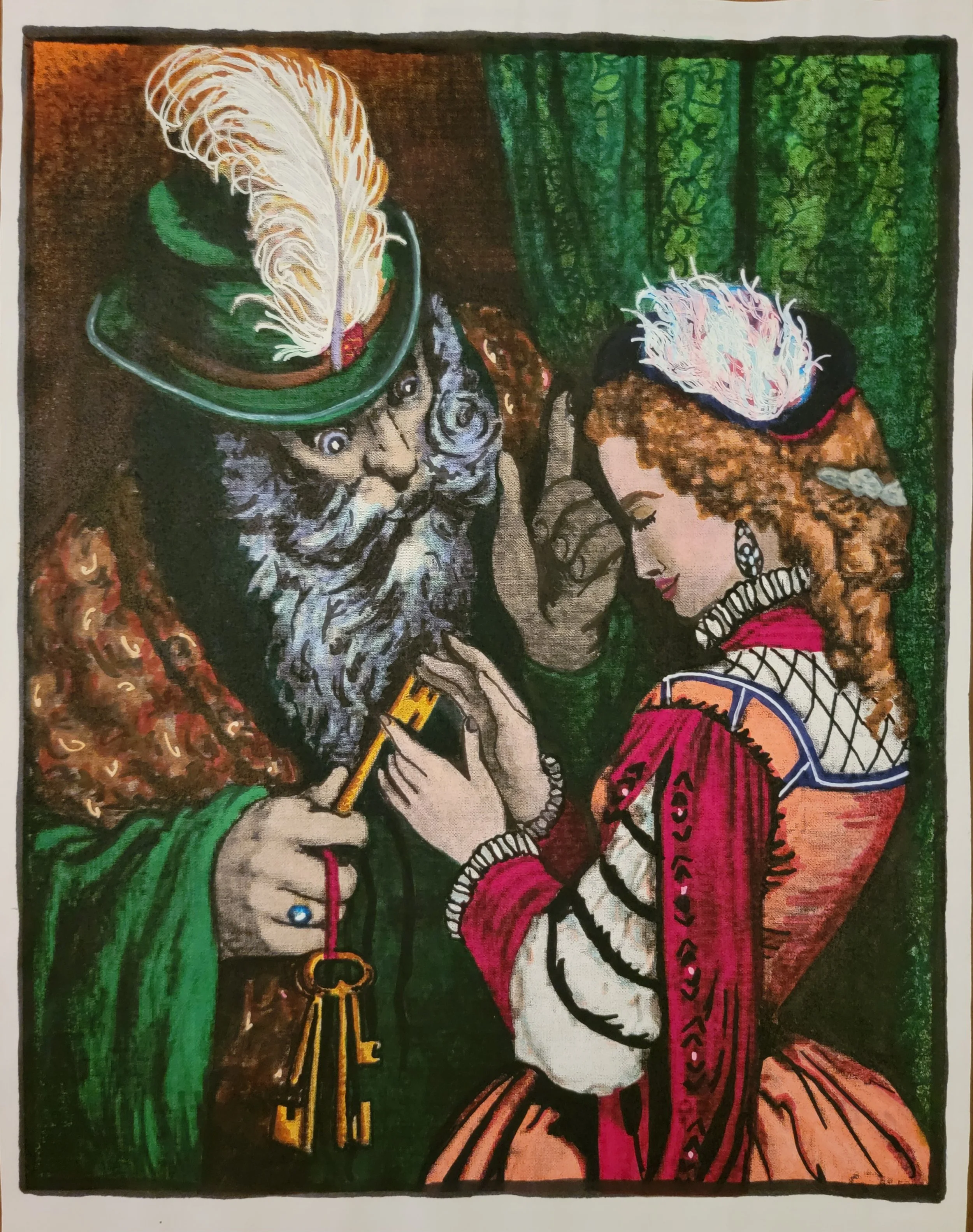
“Bluebeard” is a french fairy tale, written by Charles Perrault (published 1697). The story depicts a wealthy man (Bluebeard) who, as the story eventually discloses, repeatedly murders his wives. His new wife is given the keys to his castle but is warned not to enter one specific room. When she does, the key turns blood-red. Bluebeard is then revealed to be a controlling and violent, intent upon killing his new wife, too — ultimately, she is saved by her sister and brothers.
Amanda enjoys this story because unlike most other fairy tales, it is a tale of sibling solidarity (or platonic relationships) as a source of strength, not romance. Furthermore, it is the cunning of Bluebeard’s wife herself and her sister, Anne, which ultimately saves the wife — an upset to the usual patriarchal spin.
For this coloring page, Amanda depicts Bluebeard’s world as lush and inviting, but his eyes shine hungrily, as if he wishes for his wife to break his rules — his controlling behavior is a game and excuse.
The Second of the Spirits
Illustrated by Solomon “Sol” Eytinge Jr.
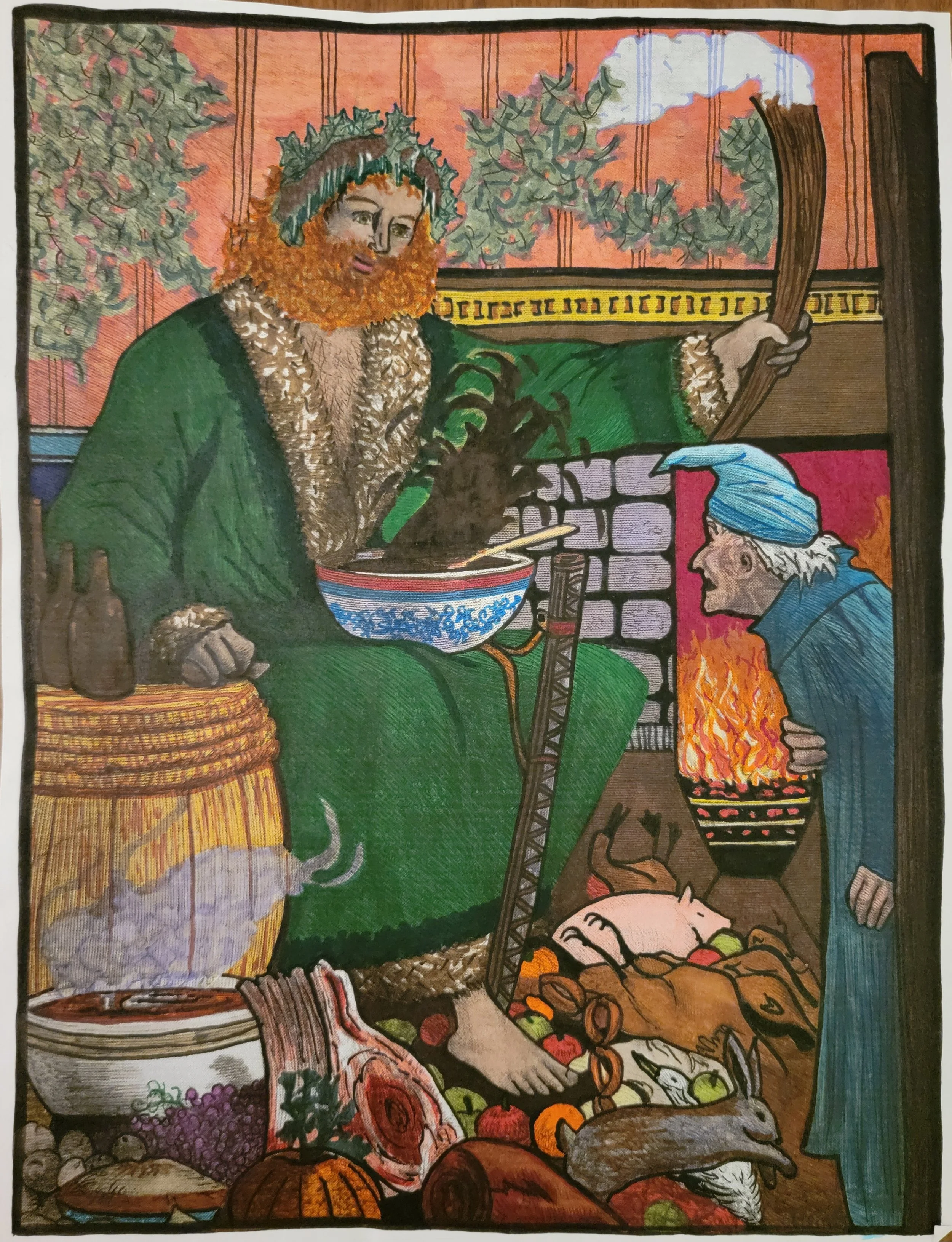
Based upon The Ghost of Christmas Present (or The Second Spirit) in Charles Dickens’ novella A Christmas Carol, Sol Eytinge Jr. depicts Scrooge’s initial encounter with the spirit at the moment when it is still jolly and its room warm and bountiful. It does not remain so for long, as it reveals the archetypal children “Ignorance” and “Want” hiding beneath his robe, a boy and a girl “yellow, meagre, ragged, scowling, wolfish; but prostrate, too, in their humility.” The spirit's rage at hypocrisy in the face of poverty is nothing to the destitution of the children, which shakes Scrooge.
Amanda leaned into the sumptuousness of the space, with saturated color and fine detail — very little is left in shadow here. It’s rich, illuminated, clearly warm and welcoming. Just imagine how this scene would change just moments later! The room must darken and the fire must go out. The feast must spoil or disappear entirely as the spirit begins to mock Scrooge and show real contempt. When Scrooge is finally confronted by the reality of his miserliness toward the working class and poor, he is left stone cold for the third ghost — the harbinger of his own death. Chills!
Rachel
Unknown Photographer Circa 1897
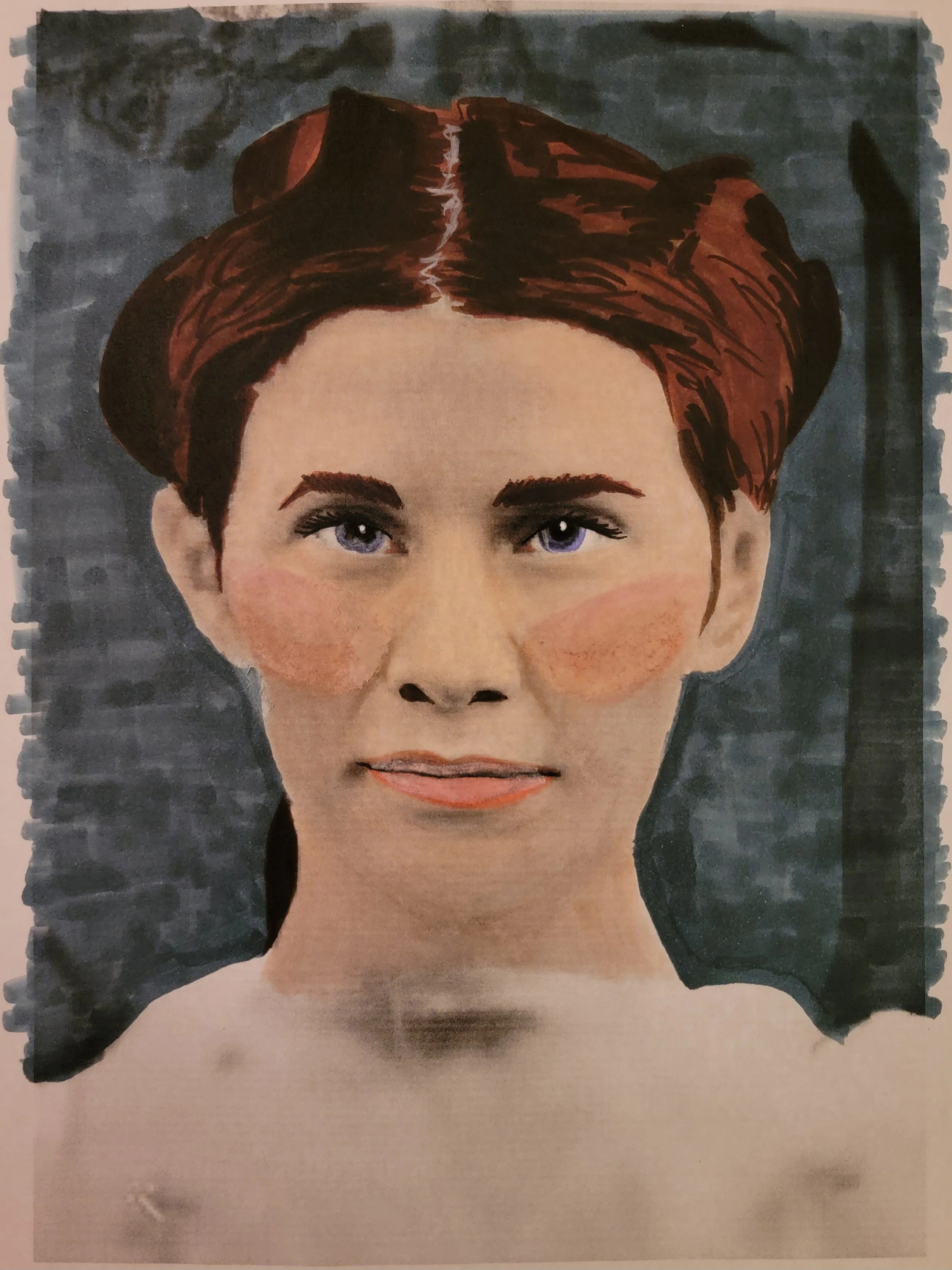
Amanda’s own ancestor, Rachel, as she looks just two years before her death (in childbirth). The only known photograph of this woman is of exceptionally low quality despite being a “professional” photo. Rachel was poor and lived in a very rural area. Photographs weren’t common among this type of family at that place and time.
For this image, Amanda used a lightboard to refine the details of the photo, then colored the image referencing the known palette of Rachel’s children (a best estimate of how she may have looked). This was done using markers, with the exception of detail work at the eyes (white gel pen) and black (fine tip sketch pen). The deficit of markers with regular printing paper is visible here, as the markers over-saturated the paper at Rachel’s cheeks, causing both paper pilling and unwanted “rust” color where the pilling occurred. Nevertheless, Amanda was happy with the results overall. More importantly, she is grateful to now have a decent image of this woman in “living color.”
From Amanda: I hope that this image encourages all of you to never give up on piecing together the stories and lives that are important to you, no matter how impossible it initially feels. Womens’ voices, those living in poverty, people of color, immigrants, the socially disenfranchised — their stories are waiting for us.
“What Are You In For?
Internet Meme, Illustration by Unknown
(If you know the origin, please let us know! 😊)
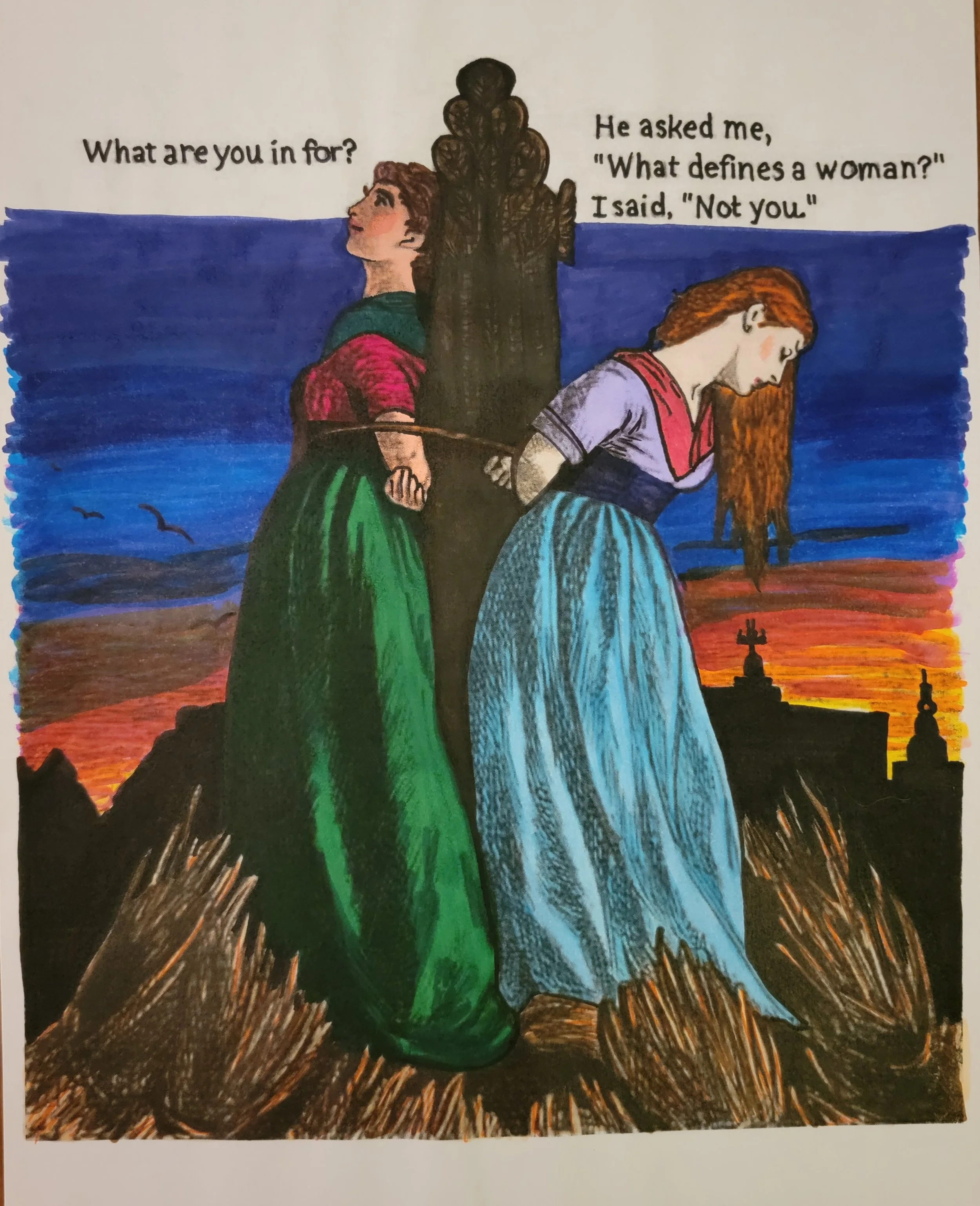
The meme for this illustration goes a number of ways, including:
Woman A: ”What are you in for?”
Woman B: ”He asked me, ‘What defines a woman?’ I said, ‘Not you.’”
“I told him the tarot cards say he ain’t shit.”
“Told him the Devil had a bigger dick.”
Amanda appreciated how ordinary the meme made the witch burnings appear — a terrific example of banal, everyday evil. Patriarchy has historically taken arbitrary, innocuous types of “defiance” by women and reacted with lethal violence. Amanda emphasized the impending fire in the sky and the vitality of the two women in both their complexions and dress. The humor punches because it belies a still present disparity between men and women that does still lead to violence.
Holiday Illustrations
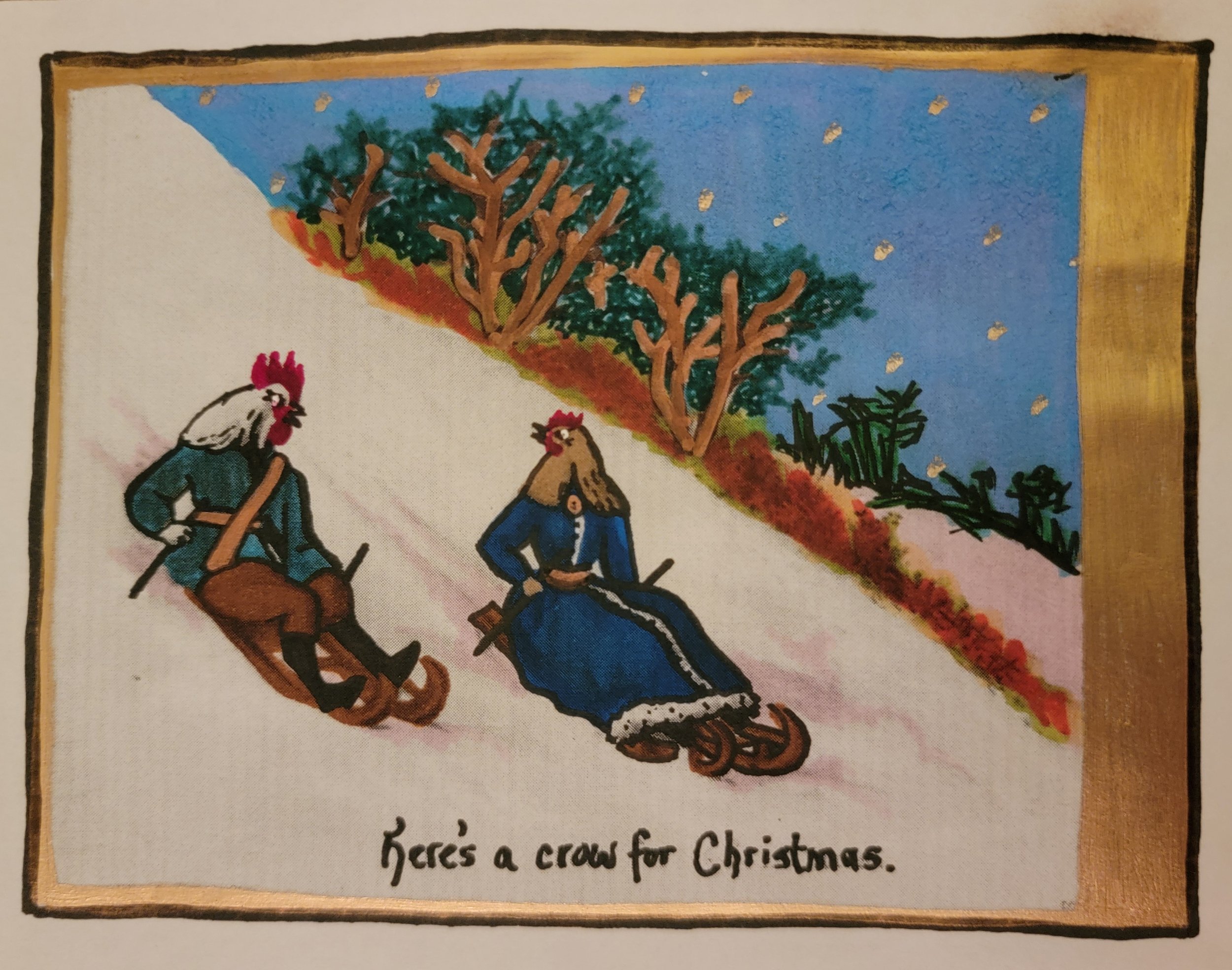
Sometimes the images are gorgeous Victorian advertisements or cards. Sometimes they’re outlandish illustrations by famous artists poking fun at us all. Sometimes they make absolutely no sense to us here in the 21st century. Sometime they’re vaguely unsettling or off-putting.
However it lands, the way artists depict holidays is ripe territory for the imagination, and perfect for coloring pages. If you look, you’ll find something wild!
Horror Coloring
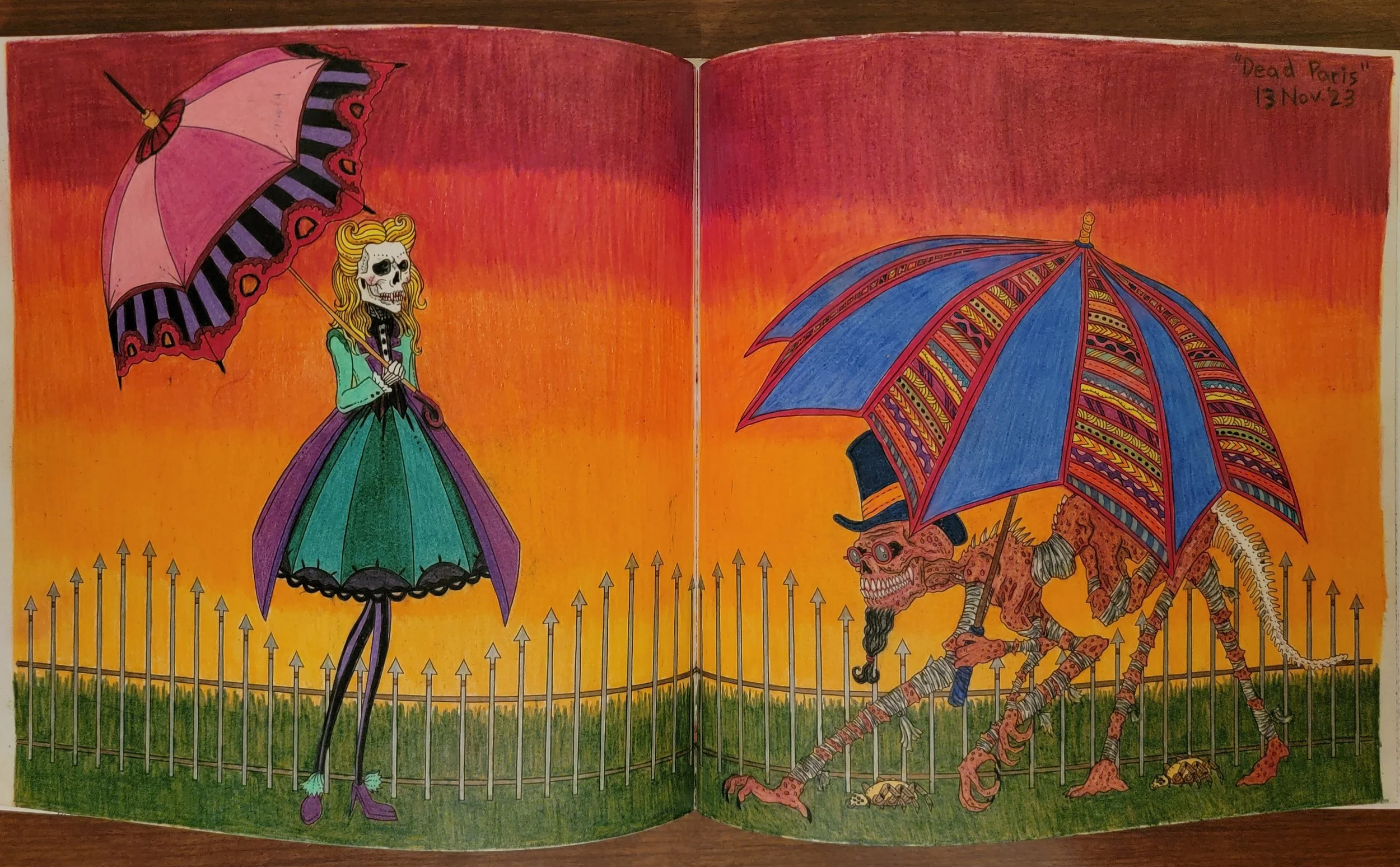
From terrific horror coloring books (especially Alan Robert’s The Beauty of Horror I & II), to historical depictions of the hell (such as illustrations of Milton’s Paradise Lost or Dante’s Inferno), to illustrations of the macabre and liminal (such as Edward Gorey) — horror coloring encourages you to think outside the box, push your creativity, find something gorgeous in unexpected places, or just lean into your inner freak.
“Strawberry Season”
Coloring Page Handed Out By PCC Market (Puget Consumers Co-Op), Seattle, Washington
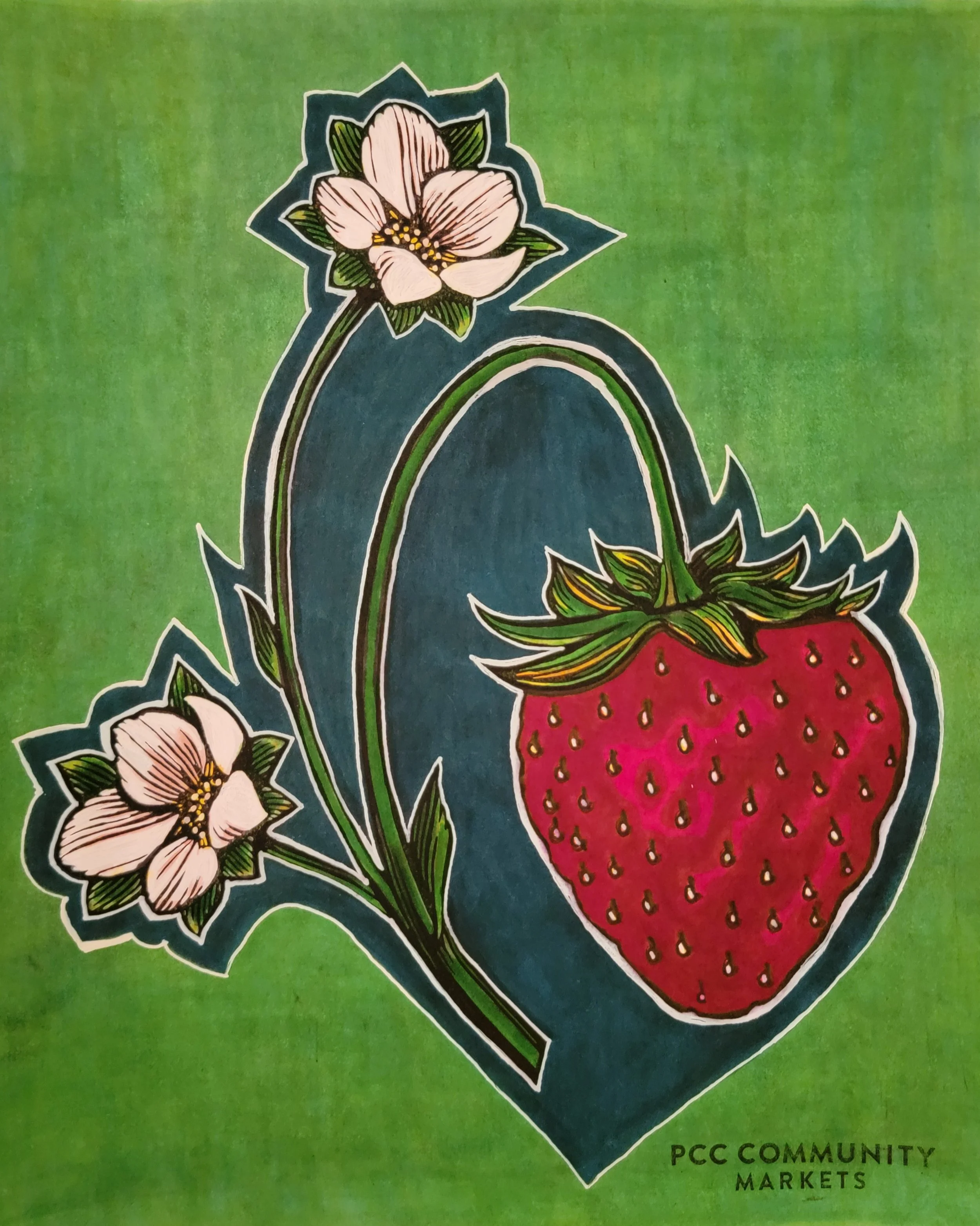
PCC Market routinely hands out coloring pages for a children’s coloring competition, and for Amanda sans competition. 😏 Even a simple coloring page can become something beautiful with some care. More importantly? This coloring page celebrates the effort to spread creativity, joy, and mutual support — even the smallest gestures count.
Amanda was inspired to frame the blooming and fruiting strawberry plant inside the partial outline of a heart, with the background saturated in spring green in order to contrast with the bright white strawberry flowers. The effect is that the colors really pop.